Finned tubes are key components in economizers, heat recovery boilers, and a wide range of air-cooled heat exchangers. They enable efficient heat recovery in gas and steam power plants, district heating systems, and in reactors and furnaces serving the chemical and petrochemical industries.
- Helical High Finned Tube
- High Frequency Helical Finned Tube
- Integrally Finned Tube
- Longitudinal Finned Tube
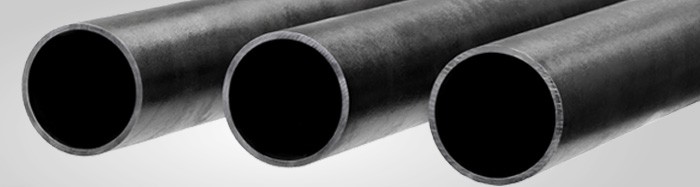
Finned Tube
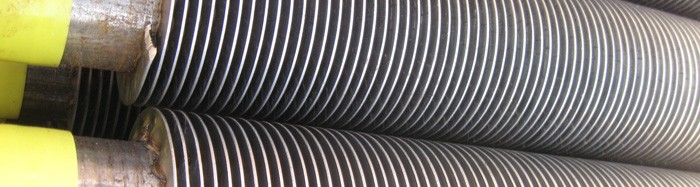
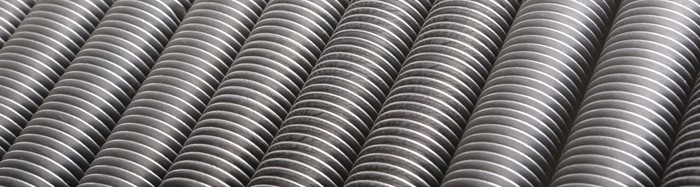
Helical high finned tubes are produced by spirally winding a fin around the base tube. They can be manufactured as single or double tubes, customized to meet specific customer requirements.
Types of HH Finned Tubes:
- Extruded Fins
- L Fin (Wrapped Fin)
- LL Fin (Overlapped Fin)
- Embedded Fin
- Knurled L Fin
These tubes are particularly well-suited for applications with dusty flue gases, such as economizers in:
- Biomass plants
- Coal-fired units
- Oil-fired units
- Waste-to-energy plants
- Air-cooled heat exchangers
A straight flue gas flow combined with optimised fin spacing minimises soot deposits on heating surfaces, ensuring easier cleaning and reduced maintenance.
High frequency helical finned tubes are essential components in economizers, heat recovery boilers, and a wide range of industrial heat exchangers, with frequent applications in the petrochemical and power generation industries.
A continuous helical fin is bonded to the tube surface using high-frequency electric resistance welding. This process creates a uniform, durable connection that ensures efficient heat transfer, excellent mechanical strength, and enhanced resistance to corrosion.
Types of High Frequency H Finned Tubes:
- Solid Fins | The fins are helically wound around the tube and continuously welded along their full length.
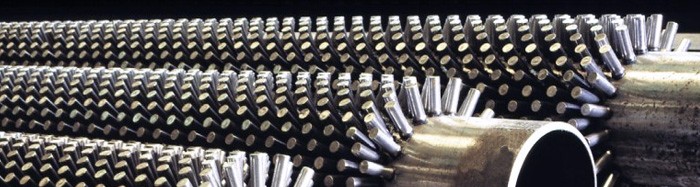
- Serrated Fins | The fin strip is slotted at short intervals, leaving a 5 mm unslotted base that forms a continuous bond with the tube. When helically wound, the slotted section of the fin strip separates at the outer edge, creating rectangular fin segments.
Fin thickness can be specified in 0.05 mm increments. The maximum fin thickness is 3.0 mm for solid fins. For segmented fins, the maximum fin strength is 2.0 mm for carbon steel.
Additional dimensions and materials can be provided upon request.
Integrally finned tubes are designed for industries that require enhanced fluid heat transfer while reducing the overall size and cost of heat exchangers. The fins are formed directly from the tube wall by a rolling process, making them an integral part of the tube itself.
This method reduces the wall thickness beneath the finned section compared to the plain ends, ensuring both compact design and high thermal efficiency.
Longitudinal finned tubes (or finned pipes) are manufactured by resistance welding fins in diametrically opposite pairs along the tube surface. This welding method creates highly efficient heat transfer channels on the tube exterior.
The fins are formed from U-shaped channels, with the base pressure-rolled and spot-welded to the tube or pipe. For structural balance and performance, the number of fins is always a multiple of four.
Grades Available: T11, T22, T5, T9, T91, T92
- ½” – 30″ diameter
- STD, 40, XH, 60, 80, 100, 120, 140, 160, XXH
- Wall thickness up to 4″ thick
- UNS: K11597, K21590, K41545, K90941, K90901, K92460